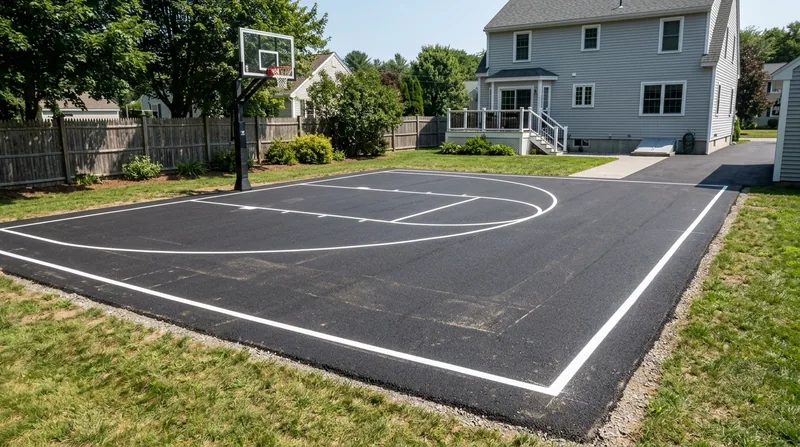




A sports court or path paving project in Portland requires more than asphalt and a paver. The region's frost heave, wet spring thaw, and glacial marine clay that dominates much of the area demand a properly engineered base and careful grading to shed water. Courts in neighborhoods from the West End down to Back Cove and out through South Portland, Westbrook, and Falmouth sit on terrain that heaves and settles unpredictably without drainage. We grade, base, and pave a flat, level surface sized for the court and the site, built to hold up through Maine's freeze-thaw cycle and the heavy foot traffic of competitive play or recreational use.
Why Sports Court and Path Paving Matters in Portland's Climate
Portland's winters expose every weakness in a court's base. Moisture trapped beneath asphalt freezes, expands, and heaves the surface upward. When the thaw comes in March and April, that same moisture softens the clay below, leaving the court soft, cracked, and unplayable. A basketball or tennis court that was level in November can be wavy and dangerous by May if the base was not built to handle the cycle. Proper grading and base preparation prevent this. We remove topsoil, compact a gravel or recycled asphalt base, proof-roll the subgrade, and then lay the asphalt surface in two courses, binder and wearing course, so the court stays true year after year.
- We grade the site to shed water away from the court and toward proper drainage.
- We install a compacted aggregate base that resists frost heave and supports the asphalt without settling.
- We lay asphalt in a binder course and wearing course, not as a thin overlay over poor base material.
- We verify flatness and level as we work, because a court surface must be playable, not just paved.
- We confirm that site drainage and any required permits are in place before we begin excavation or grading.
A well-built court base is the difference between a surface that plays true for ten years and one that fails within three or four.
Local example: A residential tennis court in Falmouth with poor drainage lasted two seasons before heaving. A new court built with proper base preparation and grading has remained flat and playable for eight years. The cost difference was modest, but the durability difference was absolute.
For more on the base work that supports durable paving, see our gravel driveway installation and grading page, which covers the same principles at a different scale.
How We Build a Sports Court or Path in Portland: Step by Step
The work begins with a site visit and measurement. We assess drainage, soil conditions, frost depth, and any utilities that may be buried. We then prepare a written estimate with tonnage specifications and a timeline. Once you approve, we schedule the work during a window when the ground is workable and weather is favorable. Most courts and paths are built in late spring or early fall, when the ground is not frozen and not waterlogged.
- We locate all buried utilities using Maine 811 before any excavation begins.
- We remove topsoil and soft material to expose stable subgrade, then grade the site to proper slope for drainage.
- We spread and compact a base course of crushed stone or recycled asphalt millings, proof-rolling as we go.
- We lay a binder course of asphalt, then a wearing course, in two separate paving passes for durability.
- We finish edges, verify flatness with a straightedge, and mark any line work the client has requested.
From excavation to final compaction, a typical court or path takes two to five days, depending on size and site access. We will coordinate with your schedule and work around any structures or utilities on site.
Portland example: A private basketball court in the West End required removal of an old gravel pad, excavation through ledge in one corner, and careful grading around a mature oak. We used Maine 811 locates to clear utilities, removed the ledge with a small excavator, built a proper base with recycled asphalt, and paved the court in three days. The court has been level and playable for five years.
If you are considering a court and want to understand the prep work involved, our asphalt driveway paving page covers base preparation in detail, and the same principles apply to courts and paths.
Methods and Surface Options for Courts and Paths
| Surface Type | Description | Best For |
|---|---|---|
| Hot Mix Asphalt (HMA) | Two-course asphalt laid at 300+ degrees, compacted to density, with a smooth wearing surface. | Basketball, tennis, multipurpose courts. Durable, fast-playing, and holds up to Maine winters. |
| Recycled Asphalt Millings | Crushed reclaimed asphalt mixed with a small amount of new binder, compacted into a firm base or wearing surface. | Walking and jogging paths, informal play areas. Lower cost, still drains well, and can be recompacted seasonally. |
| Tar and Chip | Liquid asphalt binder sprayed on crushed stone, creating a rustic, semi-permeable surface. | Rural paths, light recreational use, where a formal court is not needed and permeability is valued. |
| Gravel with Grading | Compacted stone base with proper crown and drainage, no asphalt or binder. | Walking paths, utility areas. Requires annual raking and recompacting but is the lowest upfront cost. |
For competitive courts, hot mix asphalt is the standard because it provides a fast, true playing surface and withstands heavy foot traffic. For paths and informal recreation, recycled asphalt millings or gravel with proper grading offer durability at lower cost.
Sports Court and Path Paving Cost in Portland: What to Expect
A residential basketball or tennis court in Portland typically starts at $8,500 and can reach $15,000 to $20,000 or more, depending on site conditions and the size of the court. A walking or jogging path runs lower, from $3,000 to $8,000 for a typical residential installation. These figures assume a properly prepared base, new asphalt in two courses, and all necessary grading and drainage work.
Several factors move the cost up or down. A court on a slope requires more grading and base material. Ledge excavation, common in Portland's West End and on Munjoy Hill, adds equipment time and disposal costs. Access restrictions, mature trees, or nearby structures that must be protected slow the work. A site with existing pavement that must be removed and disposed of costs more than bare ground. Conversely, a flat site with good drainage and no obstacles can be paved efficiently at the lower end of the range.
We provide a written estimate with tonnage specifications and a timeline before any work begins. The estimate is free and carries no obligation. If you want a detailed breakdown of what drives cost in a paving project, visit our pricing page for a full range of services and factors.
The best way to understand cost for your specific site is to call us at (207) 618-6493 or contact us with photos and measurements. We will schedule a site visit, measure the court or path, assess grading and drainage, and give you a firm estimate within 24 hours.
Sports Court and Path Paving Near Me: What Portland Homeowners Should Know When Hiring
A court or path paving job is a significant investment, and choosing the right contractor matters. Before you commit, verify that any contractor you consider is fully insured and carries liability coverage. Ask for a written estimate with tonnage, thickness, and a timeline, not just a price. Check references from recent jobs in Portland or nearby towns. If your court is in an HOA community, confirm that the paving material and design meet architectural standards before work begins. For any work that involves excavation or grading, the contractor must call Maine 811 for utility locates and verify with your city whether permits are required for site work at the property line.
- Get a written estimate with asphalt thickness, tonnage, and a start and finish date before signing.
- Ask the contractor for references from at least two jobs completed in the last two years in Portland or Greater Portland.
- Verify that the contractor will call Maine 811 for utility locates before any excavation begins.
- If your property is in an HOA, check the architectural guidelines and confirm that the proposed paving meets them.
- Confirm with the city or town that no permit is needed, or that the contractor will help you obtain one if required.
- Do not pay a large cash deposit upfront; a reasonable deposit is 25 to 33 percent of the estimate, with the balance due upon completion.
We are fully insured and have been in business since 2009 serving Portland and surrounding towns. We provide written estimates with tonnage and specifications, call Maine 811 before any site work, and help you navigate local permitting. Contact us for a free estimate, or call (207) 618-6493 to discuss your project.
Sports Court & Path Paving in Portland: Pricing Guide
| Service | Price | Details |
|---|---|---|
| Residential Basketball or Tennis Court | Starting at $8,500 | Includes grading, compacted base, and two-course asphalt. Price varies with site slope, soil conditions, and ledge excavation. |
| Walking or Jogging Path (residential) | Starting at $3,000 | Grading, base preparation, and asphalt surface. Longer paths or difficult terrain increase cost proportionally. |
| Recycled Asphalt Millings Path or Court Base | Starting at $2,500 | Budget-friendly option for informal play areas and paths. Requires occasional recompacting but drains well in Maine winters. |
| Site with Ledge Removal or Difficult Access | On estimate | Excavation equipment, ledge disposal, and extended grading require an on-site assessment before pricing. |
| Travel and Estimate | Included and Free | No mileage fee in Portland and surrounding areas. Free written estimate within 24 hours, no obligation to book. |
Indicative pricing, the exact cost depends on square footage, finish, and site access. Free personalized estimate within 24h at (207) 618-6493.


