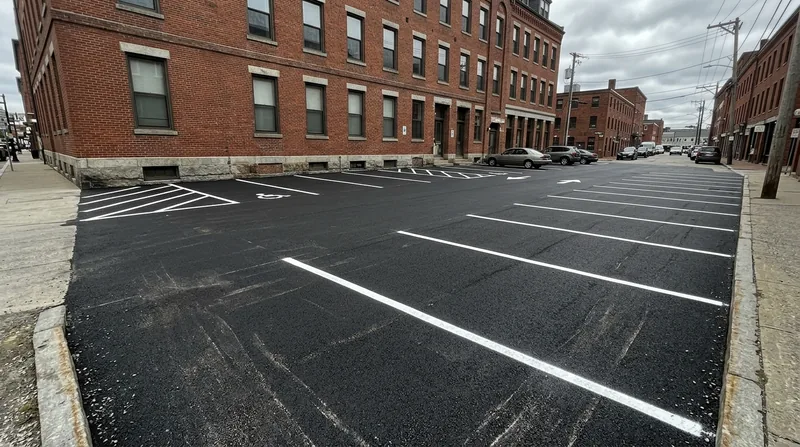




Parking Lot Paving & Construction in Portland demands a clear understanding of how the city's commercial landscape sits on glacial clay, ledge, and seasonal frost heave. From the brick Old Port blocks where water pooling in spring thaw cracks fresh asphalt, to the newer retail and office parks spreading into Westbrook and Scarborough, every lot needs proper grading, a compacted base, and hot mix asphalt laid thick enough to survive plow traffic and the brutal spring thaw cycle. We have been doing this work locally since 2009, and we know what holds in Portland's climate and what fails by mid-April. A well-built lot starts with the base, not the surface, and we grade, compact, and pave each site to handle the water and the weight.
Why Commercial Parking Lot Paving Matters in Portland's Spring Thaw Cycle
Portland's commercial lots sit in a climate where the freeze-thaw cycle is the dominant failure mode. Water enters through cracks and seams, freezes solid under the asphalt, expands, and lifts the surface into waves and potholes by March and April. A lot that was paved without proper base preparation or grading will fail in its second winter. Plow traffic accelerates edge breaking and spalling. Salt air off the harbor, especially in South Portland and near the water, corrodes asphalt edges and accelerates oxidation. The cost of patching a failed lot far exceeds the cost of building it right the first time.
- We grade and slope each lot to shed water away from the structure and toward proper drainage.
- We compact the base to the specifications required by the site and the soil conditions we find.
- We lay asphalt in two courses, binder and surface, at the thickness your lot needs to handle traffic and the thaw.
- We set the edge and seal the perimeter to keep water out of the base.
- We proof roll the base before paving to catch soft spots and prevent settling.
Proper grading and base preparation are what separate a lot that lasts ten years from one that fails in three.
Key info: Portland's clay soils hold water all winter and heave under frost. A lot paved without a compacted base and proper drainage will crack and fail by the second spring thaw. We proof roll the base and grade for positive drainage before any asphalt goes down.
For more on what makes a lot hold up over time, see our guide to Parking Lot Repair & Resurfacing, which covers the signs of base failure and when repair is worth the money.
How We Build a Commercial Parking Lot in Portland: From Grade to Finish
Every lot we build starts with a site visit and a measurement. We look at the soil, the drainage, the slope, and what the lot needs to handle. We then lay out a plan that includes grading, base preparation, and the asphalt thickness required by the traffic load and the local climate. We do not cut corners on the base, because the base is where lots succeed or fail. Once we have your approval and any required permits from the city, we begin grading and compaction, then lay the asphalt in two courses and finish the edges.
- We site-measure the lot and assess soil conditions, drainage, and existing grade.
- We remove any failed asphalt or gravel and haul it away or recycle it on-site.
- We grade the lot to shed water and meet the slope required for drainage.
- We compact the base material in lifts to the density required by the site.
- We proof roll the base to identify soft spots and correct them before paving.
- We lay the binder course and surface course, compacting each to specification.
- We edge the perimeter and seal joints to prevent water infiltration.
A new lot is ready for light traffic within 24 hours and full traffic within 48 hours, depending on weather and thickness.
Local example: A 15,000-square-foot retail lot in Westbrook required 18 inches of compacted base and 3 inches of asphalt to handle the traffic and the clay soil. We graded for positive drainage toward the rear, proof rolled the base, and paved in two courses. The lot has held solid for eight years with only routine seal maintenance.
For details on how we handle Asphalt Milling & Removal of failed surfaces, see that service page.
Parking Lot Paving Methods and Approaches
| Approach | Description | Best for |
|---|---|---|
| New Lot Construction | Full grading, base preparation, and asphalt paving from raw ground. | New commercial sites, expansions, or lots on poor or untested soil. |
| Mill and Overlay | Remove the top 1.5 to 2 inches of failed asphalt, recycle it, and lay a new surface course. | Lots with surface cracking or weathering but a sound base underneath. |
| Full-Depth Replacement | Remove and replace all asphalt and base, re-grade, and pave new. | Lots with base failure, alligator cracking, or severe rutting and pumping. |
| Patching and Spot Repair | Remove and replace failed sections, compact the base, and pave new asphalt in the repair area. | Pothole damage, localized base failure, or areas damaged by salt or plow equipment. |
| Grading and Base Only | Prepare and compact the base without asphalt, for future paving or temporary use. | Temporary parking, gravel lots, or sites where paving is planned for a future phase. |
Parking Lot Paving & Construction Cost in Portland: What to Expect
The cost of a commercial parking lot depends on the size, the existing conditions, the soil, and the approach. A new lot on prepared ground costs less per square foot than a full-depth replacement of a failed lot on clay soil. We start every project with a free commercial estimate that includes site measurement, a tonnage specification, and a written proposal before any work begins. Most lots in the Portland area run from 5,000 to 25,000 square feet, and the cost per square foot varies based on base depth, traffic load, and drainage requirements.
Factors that move the cost include the depth of the base required by the soil, the amount of existing asphalt or gravel to remove and haul, the slope and grading needed, and the thickness of the asphalt. A lot on firm ground with good drainage costs less than a lot on clay that requires 18 to 24 inches of compacted base. If you need a culvert, a curb cut, or work at the street line, permits from the city are required, and we help you navigate that process. For a realistic range and factors that affect your specific lot, see our pricing overview or call us at (207) 618-6493 for a free estimate with written tonnage and thickness specifications.
What to Look for When Hiring a Parking Lot Paving Contractor Near Portland
Hiring a paving contractor is a significant decision. You are trusting someone to prepare the ground under your lot, and poor base work will cost you thousands in repairs within two years. The strongest signal of a trustworthy contractor is being verifiably local. We have a Portland address, local plates, and we have been in business here since 2009. We show up the same day we quote you, we do the work ourselves, and we stand behind it. A contractor who arrives in a van with out-of-state plates and offers you a price on the spot, with no written estimate and no tonnage specification, is a red flag. Ask any contractor for a written estimate that includes the base depth, the tonnage, the asphalt thickness, and the timeline. Ask for references from commercial properties in Portland or the surrounding towns. Verify that they are fully insured and that they understand local permitting requirements, especially if your lot involves work at the street line, a curb cut, or a new driveway apron. If your lot is in an HOA or a master-planned community, check the architectural standards before you begin, because some HOAs restrict asphalt color or require specific finishes. Do not be swayed by a price that is too good to be true, and do not pay a large cash deposit before the work is done. Contact us for a free estimate, and we will give you the information you need to make an informed decision.
Parking Lot Paving & Construction in Portland: Pricing Guide
| Service | Price | Details |
|---|---|---|
| Free commercial estimate | Free | Site measurement, soil assessment, tonnage specification, written proposal, no obligation to book |
| New lot construction | Starting at $3 per sq ft | Grading, base preparation, and asphalt paving, cost varies with base depth and soil conditions |
| Mill and overlay | Starting at $1.50 per sq ft | Remove top 1.5 to 2 inches of asphalt, recycle, and lay new surface course on sound base |
| Full-depth replacement | Starting at $4.50 per sq ft | Remove and replace all asphalt and base, re-grade, and pave new, cost reflects base failure or poor soil |
| Spot repair and patching | On estimate | Cost depends on area size and base condition, we assess on-site and provide tonnage and thickness specs |
| Travel | Included | in Portland and surrounding areas, no separate call-out or mileage fee for commercial estimates |
Indicative pricing, the exact cost depends on square footage, finish, and site access. Free personalized estimate within 24h at (207) 618-6493.


