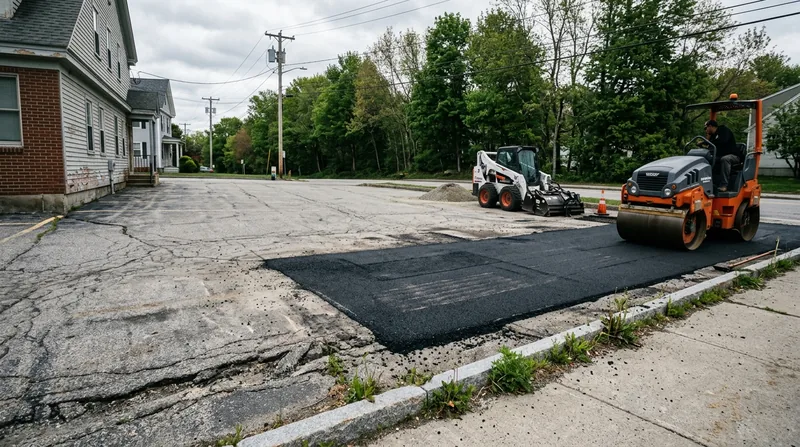




Parking Lot Repair & Resurfacing in Portland means cutting out the failed sections where plow blades have chewed the edges and clay heave has cracked the surface, rebuilding the base, and patching it flush before the spring thaw softens what's left. Portland's parking lots sit on glacial marine clay that holds water all winter, heaves under frost, then opens long cracks and alligator patterns each spring. The plow edges get the worst of it. We remove the failed asphalt, proof-roll and recompact the base, and lay new hot mix flush to the surrounding surface, so your lot drains properly and holds traffic without edge drop-off or standing water. This is not cosmetic work, it is structural repair that keeps your lot safe and extends its life by five to ten years.
Why Portland Parking Lots Crack: The Clay and Frost Cycle
Greater Portland sits on glacial marine clay that behaves like a sponge in winter. When the water freezes, it expands, and the asphalt above it cracks. Plow operators working the edges at the parking lot perimeter break the pavement further, and by March the edges are separating from the field. This is not a defect in the original paving, it is the result of Portland's freeze-thaw cycle and the soil beneath. The longer you wait to patch these sections, the faster the damage spreads, because water gets under the edges, refreezes, and pushes the asphalt further apart.
- We identify failed sections by visual inspection and by probing with a rod to find where the base has lost bearing.
- We cut out the failed area with clean, perpendicular edges so the new patch locks in mechanically.
- We rebuild the base to the original thickness and proof-roll it to confirm compaction before laying the new asphalt surface.
- We place the new hot mix in two lifts, binder and surface course, and roll it while hot so it bonds fully to the existing pavement.
The result is a patch that handles the same freeze-thaw cycle next winter without separating again.
Key info: A parking lot in Portland with alligator cracking across more than thirty or forty percent of the surface has lost base integrity. Patching those areas will hold for a season or two, but the money belongs in a full resurfacing or overlay to avoid throwing repair dollars at a failing lot year after year.
For more on what drives parking lot failure, see our guide to asphalt resurfacing and overlay, which covers the decision between patch, resurface, and full replacement.
How We Repair and Resurface Portland Parking Lots: Step by Step
Every parking lot repair job starts on-site. We walk the lot, mark the failed sections, measure the depth of good asphalt, probe the base, and check drainage. From there we decide whether to patch individual areas or recommend a full resurfacing. If the damage is localized, patching is the right call. If the lot is cracking in multiple zones, or if the edges are systematically failing, resurfacing the whole surface over a rebuilt base is the better investment.
- We mark all failed sections and establish the repair boundaries with chalk or spray paint.
- We saw-cut the perimeter of each failed area with clean, perpendicular edges and remove the broken asphalt and the failed base material beneath it.
- We inspect the subgrade, address any soft spots or water pooling, and compact the base material to original density.
- We place new aggregate base in lifts, proof-roll each lift to confirm bearing, and then place the new hot mix asphalt in two courses.
- We roll the new asphalt while hot, feather the edges into the existing pavement, and finish the surface to match the surrounding lot.
The entire process takes one to three days depending on lot size and the number of failed sections. Traffic can usually return within 24 hours of completion, though we recommend keeping heavy vehicles off for the first 48 hours while the asphalt fully cures.
Local example: A 40-space parking lot in South Portland with edge failure along the north and east perimeters, where the plow has been working the same line for five winters, typically needs 400 to 600 square feet of patching. We cut out the failed sections in two days, rebuild the base, and lay new asphalt. The lot is back in service within 48 hours and the edges stay tight for the next five to seven years if drainage is good.
For large-scale or complex lots, see our full service description for parking lot paving and construction.
Parking Lot Repair Methods: Patch, Overlay, or Full Replacement
| Approach | Description | Best for |
|---|---|---|
| Full-Depth Patch | Remove failed asphalt and base, rebuild base to original thickness, place new binder and surface course. | Edge failure, pothole, localized alligator cracking in one or two zones. Cost-effective when less than 20 percent of the lot is failed. |
| Mill and Overlay | Mill off the top 1 to 2 inches of existing asphalt, remove the milled material, inspect the base, and place new binder and surface course. | Cracking across 20 to 40 percent of the surface, surface rutting, or general wear. Preserves a good base and extends lot life by 10 to 15 years. |
| Full Resurfacing | Place a new layer of hot mix asphalt over the entire existing surface without milling or base work. | Surface wear and minor cracking on a lot with a solid base. Most economical when the base is still sound and the surface is the only issue. |
| Full-Depth Reclamation | Remove all asphalt and failed base, haul away the material, rebuild the base to spec, and place new asphalt from scratch. | Extensive base failure, severe drainage problems, or when the lot is being reconfigured. Most expensive option, reserved for lots that cannot be repaired by patching or overlay. |
The choice between these methods depends on the extent of failure, the condition of the base, and your budget. We assess the lot on-site and recommend the approach that gives you the best return on investment.
Parking Lot Repair & Resurfacing Cost in Portland: What to Expect
Parking lot repair and resurfacing in Portland ranges widely depending on the scope of failure and the method you choose. A localized full-depth patch of 300 to 500 square feet typically runs from $650 to $1,200, while a mill and overlay of a 40-space parking lot usually costs from $4,000 to $8,000. The variables that move the price are the total square footage of repair, the depth of base failure, the condition of the subgrade beneath the base, and whether the lot has drainage issues that must be addressed before new asphalt is placed.
A lot in Westbrook with localized edge failure and a solid base costs less to patch than a lot in Portland with widespread cracking and soft subgrade. Drainage work, if needed, adds cost but prevents future failure. Getting two or three written estimates, each with tonnage and thickness specified, is the standard practice and helps you compare the actual scope of work, not just the price.
We provide free estimates within 24 hours. Call (207) 618-6493 with your lot size and a description of the damage, or visit our pricing page for more detail on how we structure quotes and what factors affect the final cost.
What to Look for When Hiring a Parking Lot Paving Contractor Near Me
Parking lot repair is a structural investment, not a cosmetic one, so the contractor you choose matters. A reputable local contractor will visit your lot in person, walk the failed areas, and explain what they find in writing before work begins. Maine law requires any contract for work over $3,000 to be in writing and signed before the job starts, and your parking lot is almost certainly over that threshold. The contractor should provide a written estimate that specifies the square footage of repair, the thickness of the new asphalt, the tonnage of material, and the method they plan to use. If an estimate is vague about these details, or if the price seems too good, ask questions or get a second opinion.
Verify that the contractor carries full insurance, including general liability and workers compensation. Ask for references from other property managers or business owners in the Portland area, and call them. If your parking lot is in an HOA or a master-planned community, check the architectural standards and make sure the contractor is familiar with any restrictions on materials or methods. Permits for work at the street line and the parking lot entrance are set by the city, so verify with your local building department whether your repair or resurfacing requires a permit before you sign a contract. More information is available from Portland's municipal website.
We are fully insured, have been in business since 2009, and provide free written estimates with tonnage and thickness specified. Call us for a free estimate or reach us at (207) 618-6493.
Parking Lot Repair & Resurfacing in Portland: Pricing Guide
| Service | Price | Details |
|---|---|---|
| Localized full-depth patch | Starting at $650 | 300 to 500 square feet of failed asphalt and base, including base rebuild and new surface course |
| Mill and overlay, 40-space lot | Starting at $4,000 | 4,000 to 6,000 square feet milled and overlaid, assumes solid base and standard Portland drainage conditions |
| Full resurfacing, 60-space lot | Starting at $6,500 | 6,000 to 9,000 square feet of new asphalt over existing surface, no milling or base work needed |
| Complex or large-scale repair | On estimate | Extensive base failure, drainage issues, or reconfiguration require on-site assessment before pricing |
| Travel and estimate | Free | No mileage fee or call-out charge for Portland and surrounding service areas, response within 24 hours |
Indicative pricing, the exact cost depends on square footage, finish, and site access. Free personalized estimate within 24h at (207) 618-6493.


