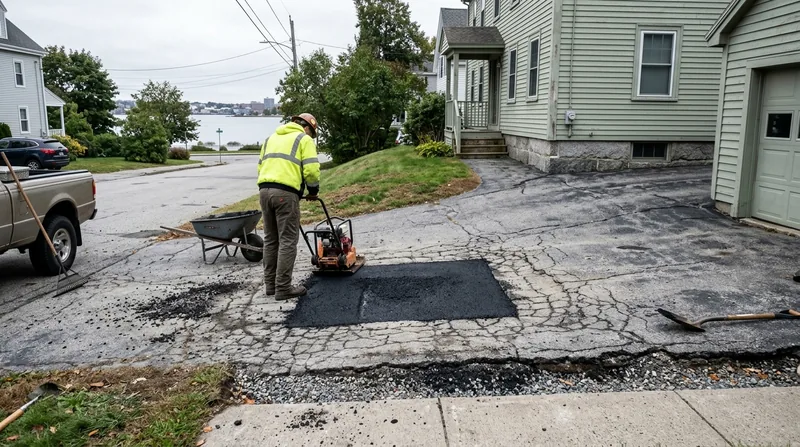




Driveway Repair in Portland means cutting out cracked and heaving asphalt, rebuilding the base underneath, and patching it flush to stop water and frost from spreading the damage further. Portland's driveways fail in predictable ways: the glacial marine clay around Back Cove and the Fore River heaves under winter frost, cracking slabs from underneath. The ledge-tight driveways on Munjoy Hill and the Western Promenade, cut straight into granite, crack differently, often in straight lines where frost gets under shallow bases. Salt air off Casco Bay eats at edges and joints near the water. We cut out the failed asphalt, rebuild the base with compacted aggregate, and lay new asphalt flush to the surrounding surface. The work stops the spread and buys you years before you face a full resurfacing or replacement. This page explains what fails, how we repair it, what it costs, and what to look for when you hire a contractor.
Why Driveway Repair Matters in Portland: Frost Heave and Clay
Portland's winter frost and spring thaw are the biggest drivers of driveway failure. The glacial marine clay that dominates the landscape from Back Cove to the Fore River holds water all winter, then expands and heaves under freeze cycles. This pushes the asphalt up and creates cracks, often in alligator patterns along the edges where snowplow blades have already weakened the surface. The ledge-heavy neighborhoods on the hills face a different problem: shallow bases cut directly into granite or schist mean little room for proper drainage, and frost gets under the thin asphalt and pops it. Left alone, these cracks widen, water gets underneath, the base softens, and what started as a repair job becomes a full resurfacing or replacement.
- Frost heave in clay-heavy soil pushes asphalt up and cracks it in alligator patterns, especially at edges.
- Shallow bases over ledge allow frost to undermine the asphalt, creating straight-line cracks and pop-outs.
- Plow damage opens edges and joints, letting water penetrate and accelerate the failure.
- Salt air near Casco Bay corrodes joints and edges, weakening the bond between asphalt and the base.
- Spring thaw softens the clay base, and the asphalt sinks or flexes, widening existing cracks.
Catching these cracks early with a repair stops the spread and keeps you out of the replacement zone. The longer you wait, the more of the driveway fails, and the more you spend.
Key info: In Portland neighborhoods like Back Cove, Deering Center, and South Portland, frost heave under clay is the number-one failure mode. A repair in spring, right after the thaw exposes the damage, stops it from getting worse over the next winter.
For more detail on what drives asphalt failure and how different repairs address it, see our guide to pothole repair and asphalt patching, which covers the same base-level mechanics.
How We Repair Your Driveway: The Process Step by Step
A driveway repair starts with a site visit to measure the failed area, check the base, and decide whether patching will hold or if you need a larger fix. We cut out the damaged asphalt in a clean line, haul it away, inspect and repair the base if needed, and lay new asphalt. The new patch gets compacted and finished flush to the surrounding surface so water runs off and doesn't collect in a low spot. Most repairs take a day or two depending on the size and weather. You can drive on the new asphalt within 24 to 48 hours, but the asphalt continues to cure for six to twelve months, so heavy loads and sharp turns should be light during that time.
- We measure the failed area and photograph the damage to understand the cause and scope.
- We cut out the cracked and heaving asphalt in a clean, straight-edged line.
- We inspect the base underneath: if it is soft, compacted, or damaged, we repair or replace it with compacted aggregate.
- We lay new asphalt in a binder course and a surface course, compacting it firmly to match the surrounding driveway.
- We finish the patch flush to the surrounding surface so water drains away and doesn't pool.
The entire process is straightforward and does not require a permit in most Portland neighborhoods unless the repair extends into the street right-of-way. If your driveway apron or entrance crosses the street line, check with your city's planning or public works department to confirm.
Example: A homeowner on Congress Street in Portland noticed alligator cracking across the center of her driveway in April, right after the spring thaw. The base underneath was soft from water and frost heave. We cut out the failed section (about 200 square feet), rebuilt the base with compacted stone, and patched it with new asphalt. The repair cost $850 and held for eight years before she chose to resurface the whole driveway. Early repair saved her thousands.
If your driveway shows broader cracking across a large area, a resurfacing or overlay may be a better choice than multiple patches. We can advise on that during the estimate.
Driveway Repair Methods: Spot Patch vs. Full-Depth Repair
| Approach | Description | Best for |
|---|---|---|
| Spot Patch (Shallow) | We remove the top 2 to 3 inches of cracked asphalt and fill it with new asphalt. The base underneath is left in place. | Small, isolated cracks or potholes where the base is still firm and not heaving. |
| Full-Depth Patch | We remove all the asphalt down to the base, inspect and repair the base if needed, and lay new asphalt in two courses (binder and surface). | Frost heave, alligator cracking, or soft base. This is the standard repair in Portland's clay-heavy areas. |
| Base Repair with Patch | We remove the asphalt, replace or compact the base with new aggregate, and lay new asphalt. The base is the main focus. | Soft, compacted, or displaced base caused by water or frost. Common in Back Cove and Fore River neighborhoods. |
| Edge and Joint Repair | We clean out failed asphalt along the edge or at a seam, compact the base, and fill with new asphalt or a binder-rich mix. | Plow damage, salt deterioration, or water infiltration at the driveway edge or where it meets the street. |
The method we choose depends on what we find when we open up the failed area. A shallow spot patch holds fine if the base is firm. But if the base is soft or heaving, a full-depth repair with base work is the only fix that lasts. This is why an on-site estimate is so important: we need to see what's underneath before we quote the work.
Driveway Repair Cost in Portland: What to Expect
A typical driveway repair in Portland runs from $450 to $1,200 for a small to medium patch, depending on the size of the failed area, the condition of the base, and whether we need to haul away debris. A simple 100-square-foot spot patch might start around $450 to $550. A 300-square-foot full-depth repair with base work runs closer to $1,000 to $1,200. Larger repairs or jobs with difficult access cost more. The estimate is free, and we provide written tonnage and thickness specs so you know exactly what you are paying for.
Several factors move the price up or down. The size of the failed area is the biggest one: larger patches take more time and material. The condition of the base underneath matters too: if the base is soft and needs replacement, the cost goes up. Access and site conditions matter: a tight driveway on a steep hill costs more than a flat, open lot in South Portland or Westbrook. Spring and early summer are the busiest times, so scheduling is easier if you call early.
We do not charge separately for travel within Portland and the surrounding area, and the estimate is free. Call us at (207) 618-6493 to set one up, or visit our full pricing page for more detail on what different repairs cost and what affects the final number.
Real example: A homeowner in Westbrook with a 250-square-foot patch of alligator cracking and a soft base got an estimate of $950. The work took one day, and the repair held for six years before she had the whole driveway resurfaced. A homeowner in Portland's West End with a 150-square-foot pothole and a firm base paid $600 and has had no further trouble in four years.
Driveway Repair Near Me: What Portland Homeowners Should Know When Hiring
When you hire a contractor for driveway repair, verify a few things before you sign. First, confirm that the contractor is fully insured and carries liability coverage. Second, get the work in writing before it starts: Maine law requires any home construction contract over $3,000 to be signed and in writing before work begins. Ask for written tonnage and thickness specs on your estimate so you know what you are getting. Third, ask for references from recent jobs in your neighborhood: a contractor who has worked in Portland and the surrounding towns should have local examples. If your driveway apron or entrance crosses the street line, check with your city's planning or public works department about permit requirements. Some Portland neighborhoods require a permit; others do not. If you live in an HOA community, check your architectural guidelines: some HOAs have rules about driveway repairs or materials. Finally, be wary of door-to-door offers or unsolicited calls about leftover asphalt from a nearby job. A reputable contractor has a local address, local references, and a written contract.
We are fully insured, have been in business since 2009, and provide free written estimates with tonnage and thickness specs. We work in Portland, South Portland, Falmouth, Westbrook, Yarmouth, and the surrounding towns. Call us at (207) 618-6493 or visit our contact page to request a free estimate. We respond within 24 hours and have no obligation clause: if the estimate is not what you expected, you owe us nothing.
Driveway Repair in Portland: Pricing Guide
| Service | Price | Details |
|---|---|---|
| Spot Patch (Shallow) | Starting at $450 | Small isolated cracks or potholes under 100 square feet with firm base underneath |
| Full-Depth Patch (100-300 sq ft) | Starting at $750 | Alligator cracking or frost heave with base repair, the standard Portland repair in clay-heavy soil |
| Large or Complex Repair (300+ sq ft) | On estimate | Multiple failed areas, soft base requiring significant replacement, or difficult site access |
| Travel | Included | No separate charge within Portland and surrounding service area towns |
| Estimate | Free | Written specs with tonnage and thickness, response within 24 hours at (207) 618-6493 |
Indicative pricing, the exact cost depends on square footage, finish, and site access. Free personalized estimate within 24h at (207) 618-6493.


